










































Skin Spot AI - The Science
AI-powered skin lesion risk assessment on any smartphone
The Science behind
Helfie's Skin Spot AI
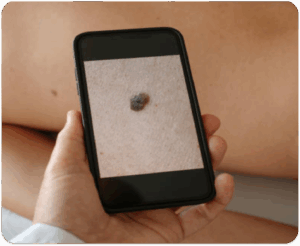
Helfie Skin Spot AI turns a compatible, camera-enabled smartphone into an intelligent screening tool that identifies and analyses skin lesions for early risk assessment. By combining computer vision, deep learning, and real-world dermatology data, Skin Spot AI offers fast, non-invasive screening for early detection and preventative care.
Using a smartphone camera, the system evaluates key visual characteristics of skin lesions, such as asymmetry, border irregularity, colour complexity, and structural patterns, to estimate whether a lesion is low, medium, or high risk.
Why this matters?
Skin cancer is one of the most common cancers worldwide, affecting more than 1.56 million people each year⁷. Many lesions develop silently, and outcomes depend heavily on early recognition⁸.
Dermatology access remains limited, with long wait times, high costs and specialist shortages, especially in rural and underserved communities9. These barriers delay diagnosis, increase risk and contribute to avoidable disease progression10 .
Helfie Skin Spot AI addresses this gap by providing immediate, low cost screening directly from a user’s smartphone. By identifying potential risk earlier, it supports timely clinical follow up, reduces unnecessary delays, and helps people monitor concerning lesions from the comfort of their home. This is particularly transformative for rural and underserved populations with limited access to dermatology services.
The science in your camera
Skin Spot AI uses a two-step deep learning pipeline:
Lesion Detection: High-resolution smartphone images are analysed using a convolutional neural network trained to locate the lesion. The model identifies features such as asymmetry, border shape, colour variation and texture to isolate the lesion for assessment.
Risk Classification: The cropped lesion is processed by a DINOv3-based vision transformer, fine-tuned on 2,298 annotated dermatology images. The model classifies lesions into:
- Low risk – benign lesions (e.g. nevi, seborrhoeic keratosis)
- Medium risk – actinic keratosis
- High risk – malignant lesions (melanoma, BCC, SCC)
This architecture uses attention mechanisms to highlight clinically meaningful features, delivering an accurate and consistent risk estimate in seconds.
Independent Validation
Skin Spot AI has demonstrated strong performance across a real-world dermatology dataset:
Reported average errors include:
- Overall accuracy: 83.7%
- AUC: 94.8%
- High-risk accuracy: 85.3%
- Low-risk accuracy: 94.5%
Sensitivity, specificity, F1 scores and a Cohen’s kappa of 0.741 reflect strong agreement with established clinical screening benchmarks. Performance remained stable across varied skin tones and device conditions, supporting reliable everyday use.