











































Helfie Checkup AI
Your key health indicators measured in seconds.

What Is Checkup AI?
your core vitals - Heart rate, HRV,
blood pressure, blood oxygen, respiratory rate
and stress levels by analysing metrics recorded from a facial scan taken by your smartphone's camera.
your vital signs, recording key health metrics
supplied by you, using your smartphone.
How to Use
Checkup AI
Checkup AI is designed to be simple, fast and accessible screening tool, providing you with wellness insights tailored to you within seconds using your smartphone.
Initiate a scan in the app following the instructions on the Checkup AI screen and position your face within the camera frame for approximately 30 seconds to record a short facial scan.
The scan captures subtle changes in skin colour caused by blood flow, which are processed by Helfie’s clinically validated remote photoplethysmography (rPPG) algorithms. The results of the algorithm process are analysed to estimate key vital signs such as heart rate, blood pressure, respiratory rate, blood oxygen saturation, and heart rate variability.
This analysis delivers a user supplied data-driven assessment of your physiological health, providing personalised insights that may support early detection, offer information for next steps and options for preventive care.

Heart Rate
In Brief
A heart rate, also known as pulse, is the number of times a person’s heart beats per minute. The normal heart rate for adults ranges from 60 to 100 beats per minute (bpm), although this can vary depending on age, physical condition, and other factors. A low heart rate (bradycardia) is generally defined as a heart rate below 60 bpm, while a high heart rate (tachycardia) is defined as a heart rate above 100 bpm. Abnormal heart rates can be caused by various factors, such as exercise, stress, medical conditions, and medications.
Why Check?
Heart rate is an important indicator of overall health and fitness, as it can provide information about the heart’s ability to pump blood efficiently. A slow heart rate can indicate that the heart is not working efficiently, while a rapid heart rate can indicate an overactive thyroid, stress, or anemia. Regular heart rate tracking may help to monitor unusual variations that may affect heart health or be indicative of other issues.

Respiratory Rate
In Brief
Respiratory rate is the number of breaths a person takes per minute. The normal respiratory rate for adults is between 12 and 20 breaths per minute, although this can vary depending on age, physical condition, and other factors.
Why Check?
A low respiratory rate (bradypnea) is generally defined as a rate below 12 breaths per minute, while a high respiratory rate (tachypnea) is defined as a rate above 20 breaths per minute. Abnormal respiratory rates can be caused by various factors, such as exercise, stress, medical conditions, and medications. Monitoring respiratory rate is important for assessing a person’s lung function and overall health. Changes in respiratory rate can indicate potential health issues, such as respiratory infections or metabolic disorders.

Heart Rate Variability - HRV
In Brief
HRV is the measurement of the time between heartbeats. HRV is considered an important marker of overall cardiovascular health and can provide information about the functioning of the autonomic nervous system. The autonomic nervous system controls many automatic functions in the body, such as heart rate, blood pressure, and digestion.
Why Check?
Checking your Heart Rate Variability (HRV) can help you monitor your cardiovascular health, stress levels, recovery, sleep quality, and physical performance. HRV provides insight into the functioning of the autonomic nervous system and cardiac function and can be used to detect changes in well-being and track progress in health and fitness.
Blood Oxygen
In Brief
Blood oxygen saturation, also known as oxygen saturation or SpO2, refers to the percentage of haemoglobin in the blood that is saturated with oxygen. Haemoglobin is the protein in red blood cells that carries oxygen from the lungs to the rest of the body.
Why Check?
Blood oxygen saturation provides valuable information about the functioning of the respiratory and cardiovascular systems. Respiratory Health: low oxygen saturation can be an indicator of problems such as asthma, chronic obstructive pulmonary disease (COPD), and pneumonia. Cardiac Health: changes in oxygen saturation can indicate changes in cardiac function and may be an early warning sign of heart disease.

Blood Pressure
In Brief
Blood pressure is the measurement of the force of blood against the walls of the arteries as the heart pumps blood throughout the body. Blood pressure is expressed as two numbers, with the systolic pressure (the top number) representing the pressure in the arteries when the heart beats, and the diastolic pressure (the bottom number) representing the pressure in the arteries between beats.
Why Check?
Blood pressure is an important indicator of overall health – providing valuable information about the functioning of the cardiovascular system. Regular blood pressure checks may help to identify and monitor indicators of: Hypertension: High blood pressure, or hypertension, is a major risk factor for heart disease, kidney disease, and stroke. Cardiac health: Blood pressure is directly related to the health of the heart and blood vessels. Changes in blood pressure can indicate changes in cardiac function and may be an early warning sign of heart disease. Effects of Medication: If you are taking medication that may affect blood pressure, monitoring your blood pressure can contribute to measuring the effects of the medication.

Stress
In Brief
Helfie AI is a technology that is able to analyse various physiological markers on a person’s face using computer vision algorithms to calculate various vital metrics including blood oxygen levels, respiratory rate, and stress levels. The technology is able to detect changes in these vital signs by comparing and analysing changes in the imagery of a person’s face. For example, blood oxygen levels can be estimated by analysing the changes to the colour of a person’s skin. When blood oxygen levels are low, the skin can appear bluish or purple, while high blood oxygen levels can cause the skin to appear reddish. Helfie AI can analyse these colour changes in the skin to estimate the person’s blood oxygen levels. Respiratory rate can also be estimated by analysing a person’s facial movements. As a person breathes, their facial muscles move in a characteristic pattern.
By tracking these movements, Helfie AI can estimate the person’s respiratory rate. Stress levels can be estimated by the Helfie AI that analyses changes to the appearance of a person’s face, such as to their skin colour, facial expressions, and muscle tension. Helfie AI uses sophisticated computer vision algorithms to analyse various physiological markers on a person’s face, providing a quick and convenient stress check. While Helfie AI can be a useful tool for generating these readings, it is important to note that these readings should not be used as a substitute for professional medical advice or treatment.
Why check?
Monitoring stress levels using a technology like Helfie AI can be valuable for a number of reasons. First, it can provide a quick and convenient way to monitor your overall health. By simply scanning your face, Helfie AI can provide estimated readings for blood oxygen levels, respiratory rate, and stress levels, which can give you a general indication of your current health status. This may be useful for people who want to monitor their health on a regular basis. Regularly monitoring your vital signs using Helfie AI technology, can help you track the effectiveness of your wellness practices. By monitoring your vital signs over time, you can see how changes in your lifestyle, such as diet and exercise, affect your health. This can help you make informed decisions about your wellness practices and make adjustments as needed. Overall, checking for wellness using a technology like Helfie AI can be a valuable tool for maintaining your health and wellbeing. However, it’s important to note that these readings should be used as a complement to, not a substitute for, professional medical advice and treatment.
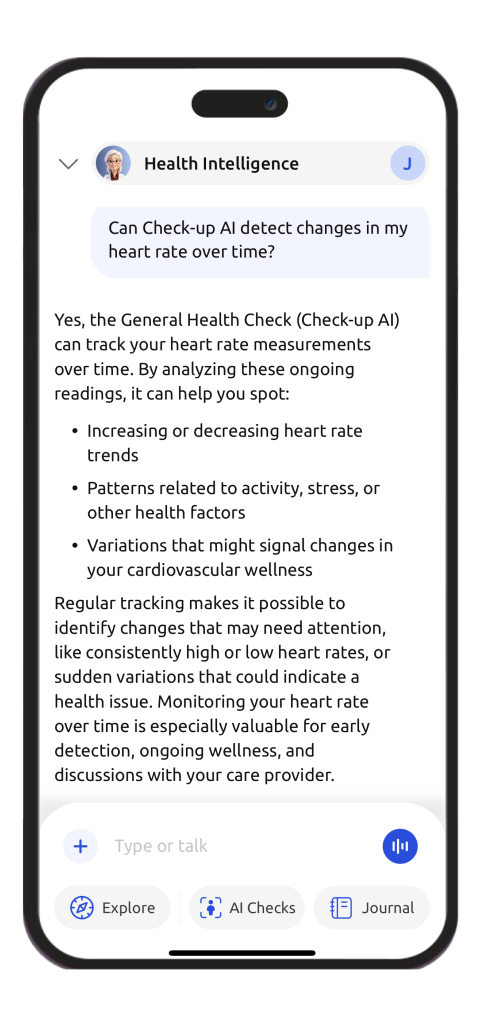
Type, talk, chat
and know more.
One of the standout features of
Helfie AI is its intelligent Checkup AI assistant,
powered by Helfie’s personal health AI. Designed to guide you through questions about your general health and providing you with informed, personalised insights.
Whether you’re curious about your heart rate, blood pressure, oxygen levels, or just want to understand and track your general wellness; Helfie’s Check Up AI with Chat mode lets you dig deeper, ask questions, and get personalized insights using your health data in seconds.

Accuracy
Helfie’s Checkup AI is fast, effortless and accurate. Backed by advanced AI and real health intelligence, it enables regular readings while continuously learning from your data and trends. It’s a smarter more accessible way to check in on your health. Anytime, anywhere.
- Accuracy (Mean Error):
- Systolic BP: ±5.27 mmHg
- Diastolic BP: ±3.95 mmHg
- Oxygen Saturation (SpO2): 0.3
- Respiratory Rate (RR): -2.11
- Heart Rate (HR): -1.19 bpm
- Heart Rate Variability (HRV): – 5.29
- Algorithm:
- Convolutional Neural Netwrok (CNN)
- Capture Mechanism:
- Face scan video via smartphone
- Research & clinical validation
- Helfie R&D labs. Adapted from published and peer-reviewed clinical research. Read more about it HERE

Trends, Data & Active Monitoring
With Helfie AI, your health data isn’t collected to sit around – It’s working for you in every interaction. Each scan, chat or upload connects your readings, analyses trends and maps subtle changes over time. Instead of isolated snapshots, you get a clear picture of where your health is heading.
Whether it’s tracking improvements, spotting early warning signs or understanding how lifestyle changes affect your vitas, Helfie AI gives you real time insights that put YOU in control.

Who's Providing This Intelligence?
Helfie’s Checkup AI connects your readings to cutting-edge medical knowledge, turning simple checks into collective intelligence and meaningful insights. Every scan is informed by deep expertise, ensuring your results are accurate and actionable.
But it doesn’t stop there. Helfie is always learning your trends, rhythms and results connecting the dots and ready to guide you with precision and context, so you can make informed, smarter decisions for your overall wellbeing.

Checks & Conversations
Every time you checkup on your health, you don’t just get numbers, you get real, intelligent insights.
Helfie AI connects your health data to a vast knowledge base, helping you understand trends, lifestyle impacts and potential next steps.
Whether you’re optimising fitness, manageing stress or simply keeping an eye on your health – Helfie ensures your every checkup is a step towards better wellbeing.

Sharing Your Data
Health is not just personal, it’s also collaborative. Helfie AI makes it easy to share your checks results and trend graphs with your doctor, carers or healthcare provider. Instead of relying on one off readings taken in a clinic, they can get a broader, more informed picture of your health.
This added information can be crucial for managing conditions such as hypertension, adjusting medications, or assessing how lifestyle changes impact your health. By sharing your trends, you ensure your healthcare provider has the insights they need to make the best recommendations for you.

Personalised Accuracy
To deliver the most precise results, Helfie’s blood pressure AI needs a few key details to calibrate your readings. These inputs help ensure your measurements are accurate and personalised to you.
Currently, Helfie will use the following inputs for this check: Age, Birth Sex, Height and Weight.
Checkup AI - The Science
Helfie’s checks are backed by the latest research and science.
Understand the science and technology behind our Checkup AI check.